



 Measures for Tsunami Striking Nuclear Power Station in Japan
 Planning and Consideration on SFR R&D Activities in China
| Vol.1 No.2 ← GA 6 - 7 - AA 8 - 9 - NT 10 - 11 - 12 - 13 → Vol.1 No.3 | ||
 |
||
| Vol.1, No.3, NT12
|
||
Laser Peening Technology for Preventing Stress Corrosion Cracking for BWR reactor internals |
||
| TOSHIBA CORPORATION | ||
KEYWORDS: |
||
| 1. Technical summary | ||
| Classification (I: Inspection, II: Repair, III: Replacement, IV: Preventive Maintenance, V: Others) | ||
| Laser Peening (LP) is a method of SCC mitigation that eliminates surface tensile stress using the impulsive effect of high-pressure plasma induced by irradiation with high-power laser pulses in water. Its effects for stress improvement and SCC-mitigation of laser-peened materials were confirmed through SCC tests for austenitic stainless steels and nickel-based alloys. |
||
|
||
|
||
| 2. Scope | ||
(1) Components |
||
|
||
| 3. Features | ||
(1) LP is a fully-controlled process for each pulse under predetermined conditions (pulse energy, spot diameter, etc.). |
||
|
||
|
||
| 4. Examples of Application | ||
| (1) Core Shroud of BWR plant (5 plants) (Fig.7) (2) RPV Bottom of BWR plant (4 plants) (Fig.8) (3) Portable LP System (Fig.9,10) New smaller and robust LP system, called Portable LP(PLP),has been developed and ready for field application. |
||
| ||
| ||
| ||
Fig.10 Portable LP System Mockup (Underwater) | ||
| 5. Reference | ||
| (1) Guideline for Preventive Maintenance Method “Peening Method”, JANTI-VIP-03-rev.2, JANTI(Japan Nuclear Technology Institute)(in Japanese) (2) “Underwater Laser Peening”, M.Yoda, B.Newton, Welding and Repair Technology for Power Plants Eighth International EPRI Conference June 18-20,2008 Fort Myers, Florida (3) “Development of Portable Laser Peening Systems for Nuclear Power Reactors”, I.Chida, T.Uehara, M.Yoda, h.Miyasaka, H.Kato, Proceedings of ICAPP(2009) (4) TOSHIBA Corporation Home Page (http://www.toshiba.co.jp/nuclearenergy/me/laser/l_01.htm) |
||
| 6. Contact | ||
| Japan Society of Maintenology (ejam@jsm.or.jp) | ||
 |
|---|
 |
|
|
Vol.10 No.2(Aug) |
|
| < Other Issues | |
|---|---|
 |
|
|---|---|
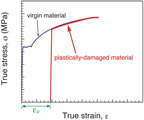 |
A New Mechanical Condition-based Maintenance Technology Using Instrumented Indentation Technique |
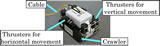 |
Survey robots for Fukushima Daiichi Nuclear Power Plant |

Contacts
(EJAM): ejam@jsm.or.jp
(JSM): secretariat@jsm.or.jp
HP: http://www.jsm.or.jp
(in English)
_Fundamental_Process_of_Laser_Peening(LP).png)
_LP_Scan_Method.png)
_Scope_of_LP_for_BWR_reactor_internals.png)
_Depth_profile_of_residual_stress.png)
_Depth_profile_of_residual_stress.png)
_Creviced_Bent_Beam_Test_Result.png)
_Experience(1)Core_Shroud_of_BWR_plant.png)
_Experience-(2)RPV_Bottom_of_BWR_plant.png)
_Portable_LP_System.png)
